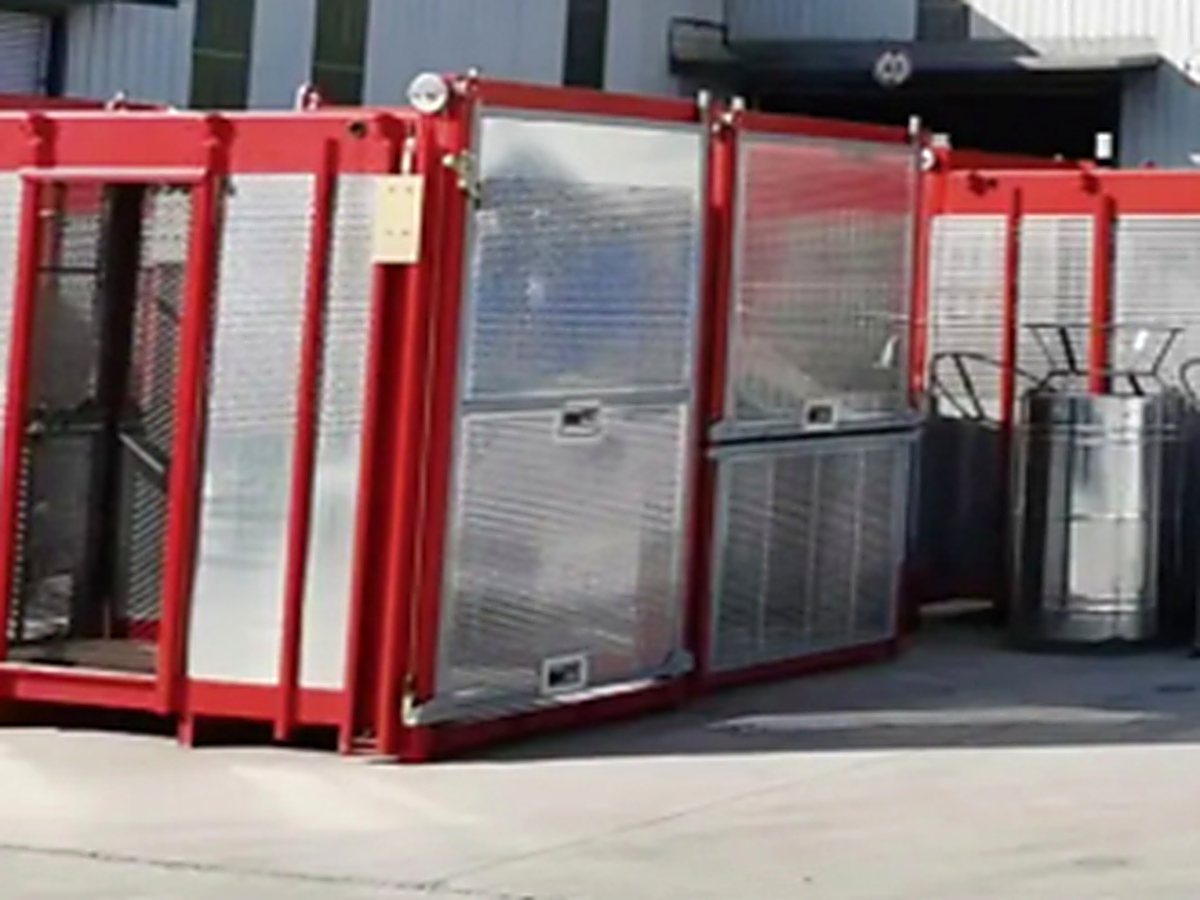
Construction hoist
Configuration summary
Dual-drive-per-cage configuration for masts beyond 200 m, 0–63 m/min, with redundant braking and enhanced tie-in design.
- Model
- SC200/200 Dual-Drive High-Lift Hoist
- Series
- VFD series
- Design standard
- GB/T 10054 · JGJ 215
- Mast section
- 650 × 650 × 1508 mm
- Packing
- Steel frame, 40HQ
- Warranty
- 12 months on main parts
Final specifications are confirmed on the project configuration sheet.
Above 200 m the mast behaves differently: wind loads dominate and single-drive units run out of safety margin. The dual-drive version doubles traction capacity and keeps a redundant brake on each cage.
Key features
- Two drive units per cage, load shared
- Redundant braking circuit
- Reinforced mast section and 6 m tie-in
- Wind-speed interlock recommended
Specifications
| Rated load | 2 × 2,000 kg |
|---|---|
| Lifting speed | 0–63 m/min |
| Max. lifting height | 250 m |
| Cage size | 3.2 × 1.5 × 2.5 m |
| Motor power | 4 × 15 kW VFD |
| Braking | Dual redundant |
| Tie-in spacing | 6 m |
| Mast section | 650 × 650 × 1508 mm, reinforced |
Typical applications
Super high-rise above 200 m, TV towers, chimneys and long-span bridge pylons.
Specifications are confirmed on the project configuration sheet. Send your building height and payload for a tailored quotation.
How the hoist is packed and shipped
Cages and mast sections are packed in welded steel frames, electrical parts in plywood cases, and the whole set is loaded into 40HQ containers at Qingdao port.
- Cage and drive unit in a steel frame
- Mast sections bundled by length
- Electrical cabinet in a sealed case
- Loading plan and packing list provided
FOB Qingdao
CIF / CFR
40HQ / 40GP
20GP
Before you order
What is the difference between the SC and SS series?
The SC series is a rack-and-pinion hoist with a cage, used to carry people and materials; the SS series is a material hoist with a platform or bucket, intended for goods only. SC units need a proper foundation, tie-ins and an operator; SS units are lighter and cheaper to install.
How high can a single hoist run?
Standard SC200/200 configurations reach 200 m with 650×650×1508 mm mast sections and tie-ins every 6–9 m. Beyond that we supply dual-drive units and project-specific tie-in calculations.
Which documents come with the shipment?
Each order includes the foundation drawing, mast and tie-in layout, electrical schematic, operation and maintenance manual, and the safety device certificate — in English as standard.